

 Back to content
You're Only As Strong As Your Weakest Link
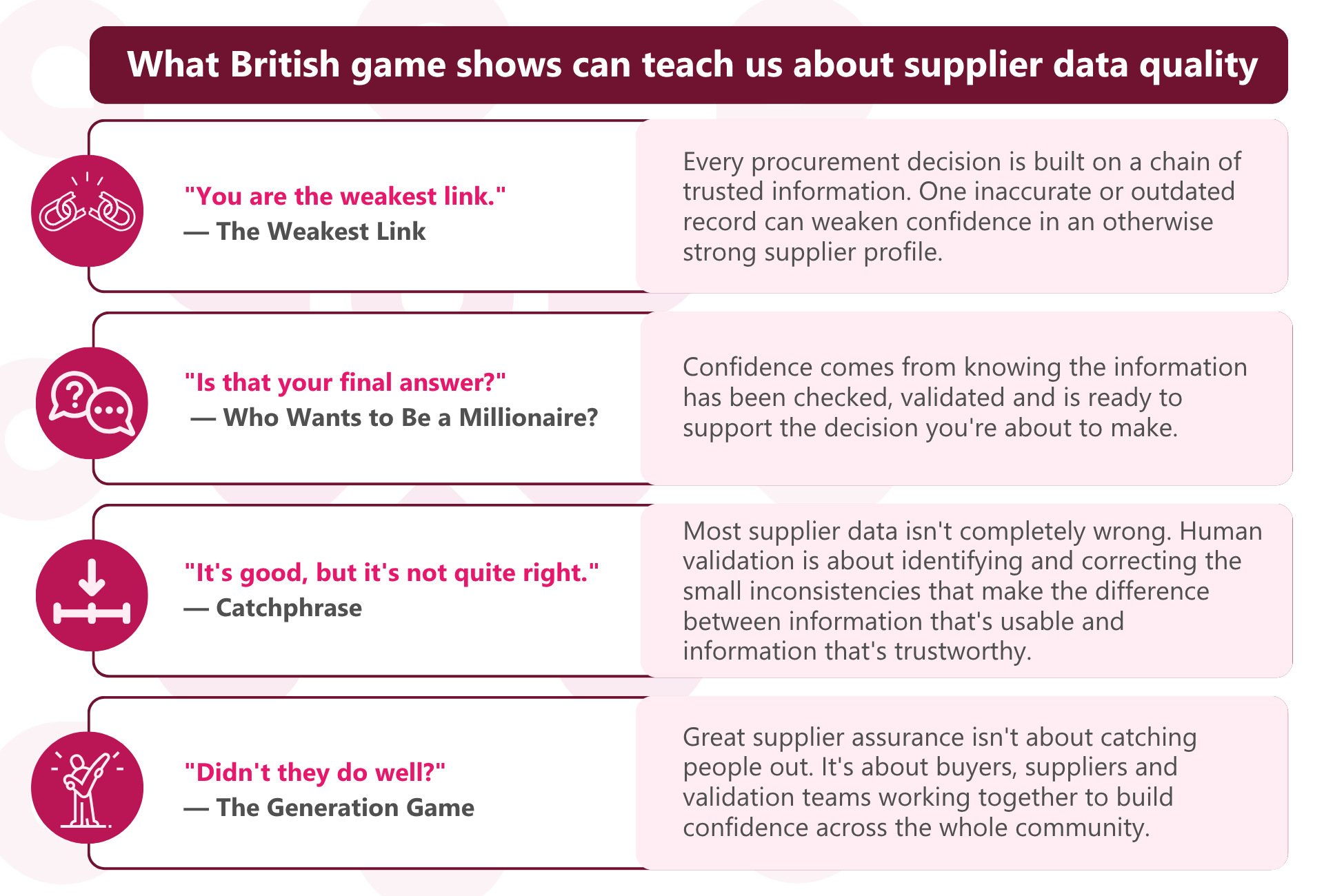
What British game shows can teach us about supplier data quality.

What British game shows can teach us about supplier data quality.

British game shows have given us some unforgettable catchphrases over the years. They're entertaining, memorable and, perhaps surprisingly, offer a useful way to think about supplier assurance.
From Anne Robinson ruthlessly eliminating contestants on The Weakest Link, to Chris Tarrant asking millionaire hopefuls if that was their "final answer", these shows turned getting the right answer into great television.
Add Roy Walker telling Catchphrase contestants, "It's good, but it's not right", and Bruce Forsyth celebrating a job well done on The Generation Game, and you have four very different shows built around a surprisingly similar idea.
Because when you strip away the flashing lights and studio audiences, they all have one thing in common: success depends on recalling and presenting the correct information.
That's exactly what procurement and supplier assurance teams do every day.
"You Are the Weakest Link. Goodbye."
The Weakest Link | 2000–2012 original run | Hosted by Anne Robinson
First broadcast in 2000, The Weakest Link saw contestants work together to build chains of correct answers before voting one another out at the end of each round. At the centre of it all was Anne Robinson, whose famously formidable presenting style made her final dismissal of the eliminated contestant instantly recognisable: "You are the weakest link. Goodbye."
The premise was simple. A team could answer dozens of questions correctly, but a weak link could break the chain and cost everyone.
Supplier assurance works in much the same way.
In supplier assurance, the weakest link isn't the supplier itself. It's the missing, outdated or inaccurate information that compromises confidence across the supply chain.
Every procurement decision is built on a chain of trusted information. Buyers rely on certifications, policies, financial information and company data to understand risk and make informed decisions. When one piece of that information is incomplete or inaccurate, confidence in the whole picture begins to weaken.
That's where validation strengthens the chain. Supplier information is reviewed, supporting documents are checked and inconsistencies are identified and resolved, helping to make sure every link is as reliable as the next.
It's not about finding fault with suppliers. It's about making sure they're represented accurately and giving buyers information they can rely on.
Because in supplier assurance, you're only as strong as your weakest link.
"Is That Your Final Answer?"
Who Wants to Be a Millionaire? | 1998–2014 original run | Hosted by Chris Tarrant
In Who Wants to Be a Millionaire?, contestants faced a series of increasingly difficult multiple-choice questions as they worked their way towards the £1 million prize.
But giving an answer wasn't enough. Before it was locked in, host Chris Tarrant would ask the question that became synonymous with the show:
"Is that your final answer?"
It was the moment that turned an answer into a decision. Contestants could pause, reconsider what they knew, weigh up the options or use a lifeline. But eventually, they had to be confident enough in the information available to commit.
Procurement decisions may not always have a million-pound prize attached, but what's at stake can be worth considerably more.
Whether approving a new supplier, renewing a contract or assessing ongoing risk, there comes a point when procurement teams also have to turn information into a decision. And to do that confidently, they need to know that the information in front of them is complete, current and trustworthy.
That's where validation helps remove uncertainty. Supplier information is reviewed, evidence is checked and inconsistencies can be resolved before that information is relied upon to make important decisions.
It's not about adding another layer of administration. It's about giving buyers greater confidence in the information behind the choices they make.
So, when the time comes to give your final answer, you can be confident in what's informing it.
"It's Good, But It's Not Quite Right"
Catchphrase | Roy Walker era: 1986–1999 | Hosted by Roy Walker
For more than a decade, Roy Walker challenged Catchphrase contestants to identify familiar phrases hidden behind animated pictures on a screen.
Sometimes a contestant would get tantalisingly close. They could see what the picture was getting at, but their answer wasn't quite accurate enough. That's when Roy would deliver one of his most memorable lines:
"It's good, but it's not quite right."
It might also be one of the most accurate descriptions of supplier data you'll ever hear.
Most supplier information isn't completely wrong. In fact, the vast majority is good.
But sometimes it's a document that's expired. A company registration that's changed. A policy that's been updated but not uploaded. Or a small inconsistency between two records.
It's good. But it's not quite right.
And in supplier assurance, the details matter.
That's where human validation makes the difference. Hellios' Validations team works directly with suppliers to review information, check supporting evidence, resolve inconsistencies and clarify responses before that information is relied upon by buyers.
It's not about catching suppliers out or marking an answer as "wrong". It's about working with them to make sure the information representing their organisation is accurate, complete and supported by the right evidence.
Last year alone, Hellios' UK and Ireland Validation team handled more than 55,000 comments.
That's 55,000 interactions where a question could be clarified, a document checked or a piece of information brought up to date.
Because when something is good, but not quite right, sometimes it takes a human to spot the difference.
"Didn't They Do Well?"
The Generation Game | Bruce Forsyth eras: 1971–1977 and 1990–1994 | Hosted by Bruce Forsyth
The Generation Game was built around ordinary people taking on a series of challenges, from memory tests and quizzes to attempting practical skills they'd only just been shown.
Part of the show's charm was watching contestants give everything a go, whether they mastered the challenge or not. And Bruce Forsyth was always ready with some encouragement.
"Didn't they do well?"
It's a sentiment that feels particularly fitting for supplier assurance, because good assurance isn't the work of one person or one team.
Buyers need accurate information to make informed decisions. Suppliers put time and effort into providing that information and keeping it current. And validation teams work with them to check the detail, resolve inconsistencies and make sure the information being shared can be relied upon.
When each plays their part, everyone benefits. Buyers gain greater confidence in the information behind their decisions, while suppliers can be confident that their organisation is being represented accurately.
Confidence isn't something you collect. It's something you build.
And it takes buyers, suppliers and validation teams working together to build it.
Now that's a job well done. Didn't they do well?
The Final Answer
Whether it was The Weakest Link, Who Wants to Be a Millionaire?, Catchphrase or The Generation Game, every great game show had one thing in common: success depended on getting the right answer.
So, what is the "right answer" in supplier assurance? The one that's true.
And that's exactly why validation matters. It helps ensure the answers reflect reality, creating confidence on both sides of the relationship. Buyers know they're making decisions using trusted information, while suppliers know they're being represented accurately and fairly.
Want to know more?
If you'd like to strengthen confidence in your supplier assurance process, speak to the Hellios team to discover how our validated supplier communities can help.